Acosta Ñu
The origin of Paraguay’s Children’s Day · 16 August 1869 · Cordillera campaign
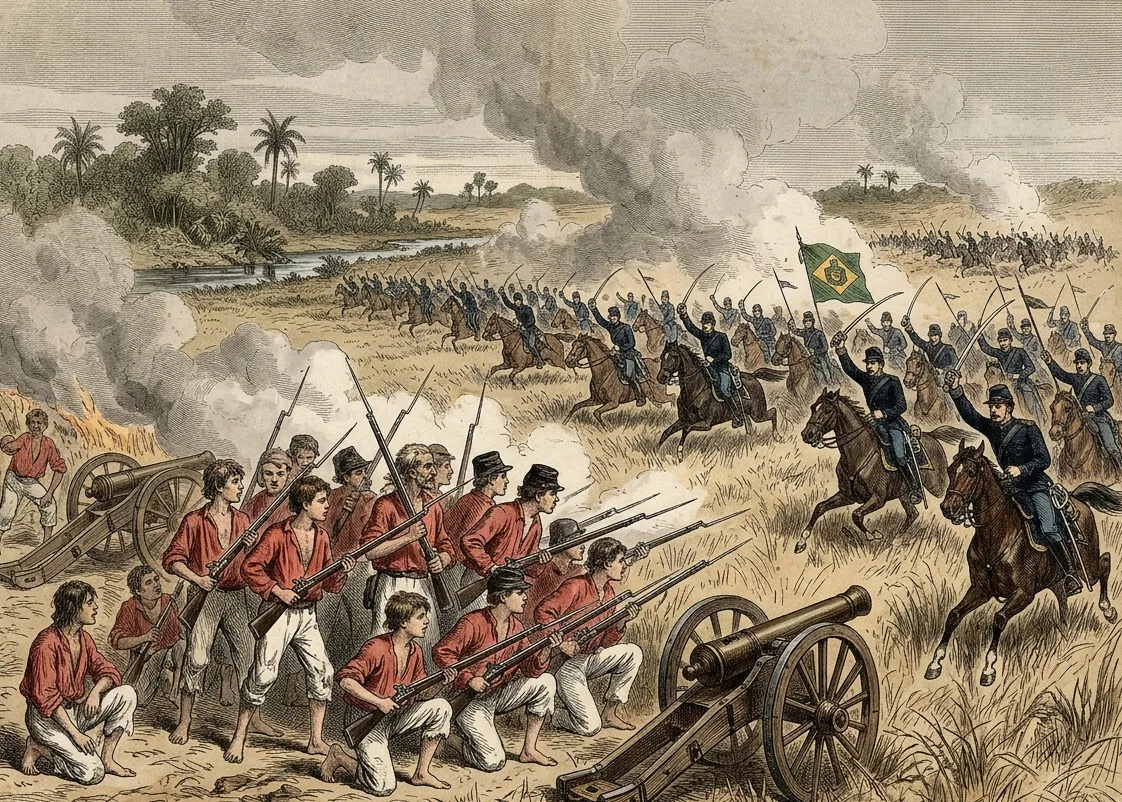
Battle card
| Date | 16 August 1869 | |
|---|---|---|
| Location | Acosta Ñu (Campo Grande, Ñu Guasu), beside the Yuquyry stream, near Barrero Grande, today Eusebio Ayala | |
| War | Triple Alliance · Cordillera campaign | |
| Duration | From 8:30 a.m.; five to eight hours ‡ | |
| Result | Allied victory. Caballero's rearguard is destroyed, but López escapes to the north. | |
| Paraguay | Empire of Brazil and Argentina | |
| Commanders | General Bernardino Caballero (rearguard) Marshal Francisco Solano López, absent: on the march toward Caraguatay | Gastão de Orléans, Count of Eu (commander in chief, present on the field) Colonel Luis María Campos (Argentine column) |
| Forces | 3,500 to 6,000 ‡: a core of 600 to 1,000 veterans, boys aged 12 to 15, old men and wounded ‡ | About 20,000 ‡: Brazilian 1st and 2nd Corps, a cavalry division and the Argentine column |
| Artillery | 8 to 12 old smoothbore pieces ‡ | Field batteries with rifled cannons; number not found in the sources consulted |
| Weapons | Flintlock muskets, lances and machetes; very little ammunition | Rifled percussion muskets; cavalry with lance, saber and carbine |
| Casualties | 1,794 to about 2,000 dead; up to 3,300 in another version ‡ 1,200 to more than 1,800 prisoners ‡ | 26 to 182 dead and 259 to 431 wounded ‡ |
‡ Figure disputed among sources. The Paraguayan figures come mainly from the postwar memoirs of General Francisco Isidoro Resquín; the allied ones, from Brazilian military histories. Not all of the allied army went into combat. Uruguay was a member of the alliance, but no Uruguayan troops are documented in this battle.
A note to the reader
Each page carries a mark that shows what kind of information you are reading.
The plates in this work are contemporary illustrations, made in the manner of period engravings. They are not original documents.
The retreat
On 12 August 1869, Piribebuy, the provisional capital, fell. For López, the Azcurra line was no longer of any use.
On hearing the news, the marshal ordered Azcurra and Caacupé abandoned. The last Paraguayan army set out north, toward Caraguatay, divided into two columns. In front went López and General Francisco Isidoro Resquín. Behind, closing the march, came the column of General Bernardino Caballero.
Caballero's column
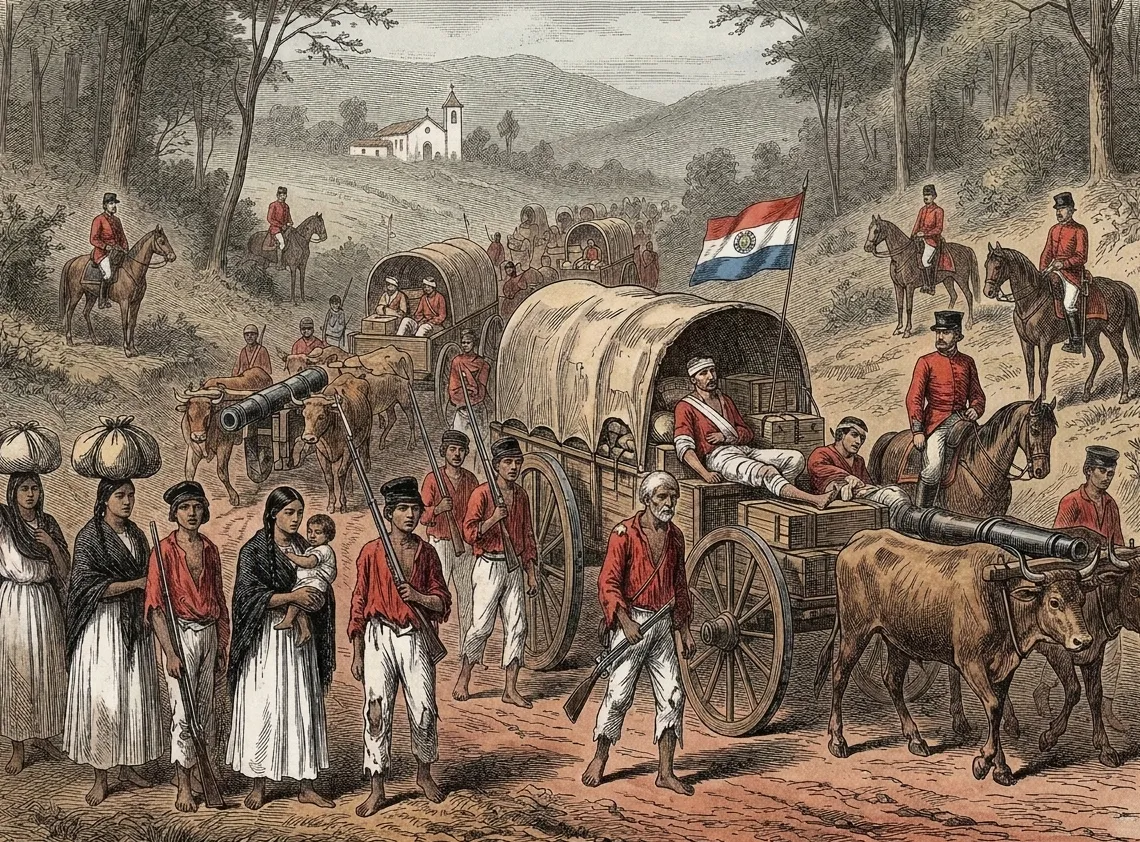
Caballero's column was the slowest.
It carried the artillery, the ox carts with ammunition and provisions, the wounded and the sick. With it also marched women, old people and children who followed the army in search of protection and food.
Caballero was 30 years old. He was the horseman of Tatayibá and had been a brigadier general since July 1868. On 15 August, the Count of Eu entered Caacupé with the main body of the allied army. From there he sent a cavalry division toward Barrero Grande, today Eusebio Ayala, to cut off the Paraguayan rearguard.
Two unequal forces
At Acosta Ñu, two very different forces clashed.
On the Paraguayan side, Caballero's rearguard numbered between 3,500 and 6,000 people, depending on the source. It had 8 to 12 old cannons, flintlock muskets, lances and machetes, and very little ammunition.
On the other side was the Count of Eu's army: about 20,000 men, though not all of them went into combat. It was not a battle of Brazilians alone. The 1st and 2nd Corps of the imperial army fought, along with a cavalry division and the Argentine column of Colonel Luis María Campos, with rifled percussion muskets and rifled cannons.
The children of Acosta Ñu
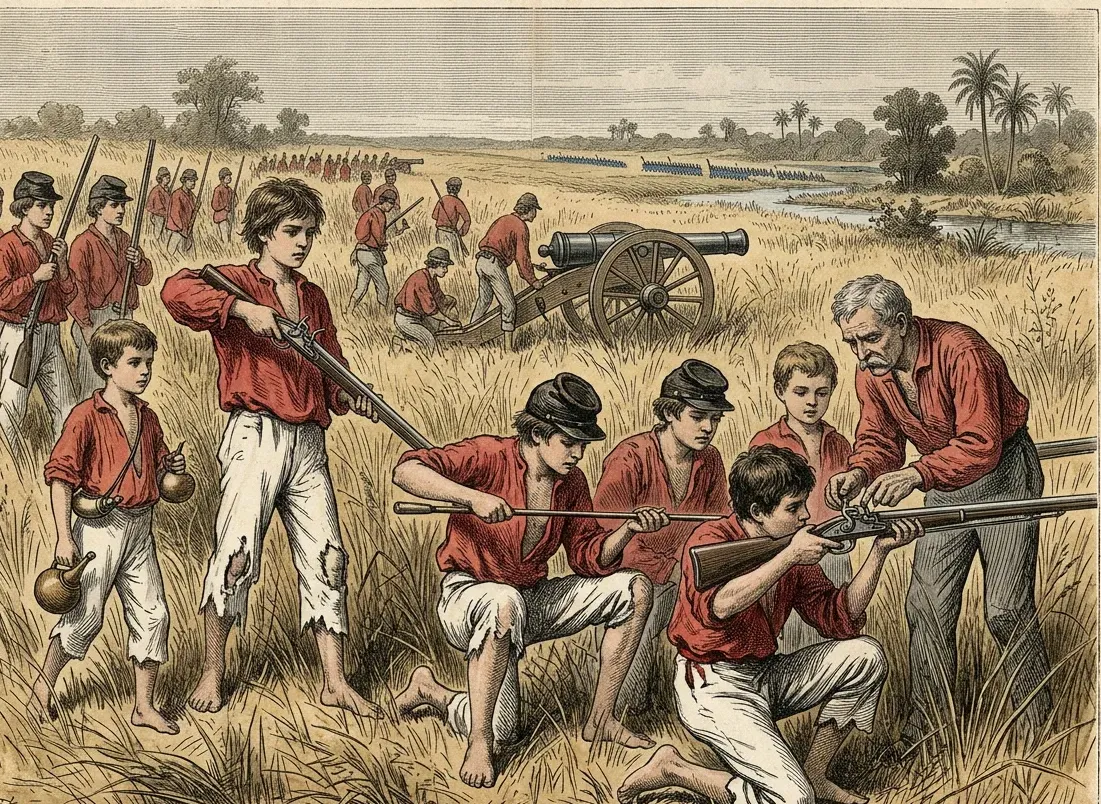
There were many boys in Caballero's ranks.
By 1869 there were almost no adult men left in Paraguay. According to the historians Herib Caballero Campos and Ángel Piccinini, that year the age of recruitment was lowered to 12. Caballero Campos estimates that at Acosta Ñu there were between 800 and 1,000 veteran soldiers, and that many others were 12 to 14 years old: “not little children”, he specifies. Other sources speak of children aged 9 to 15.
A much-repeated story says the youngest were given false beards to look like adults. That detail does not appear in any known period source, and the historians consulted give it no credit. It is also said that there were women with lances at the head of groups of children: this is tradition. The Brazilian witnesses described women who fought at Piribebuy, four days earlier, not at Acosta Ñu.
The first volley
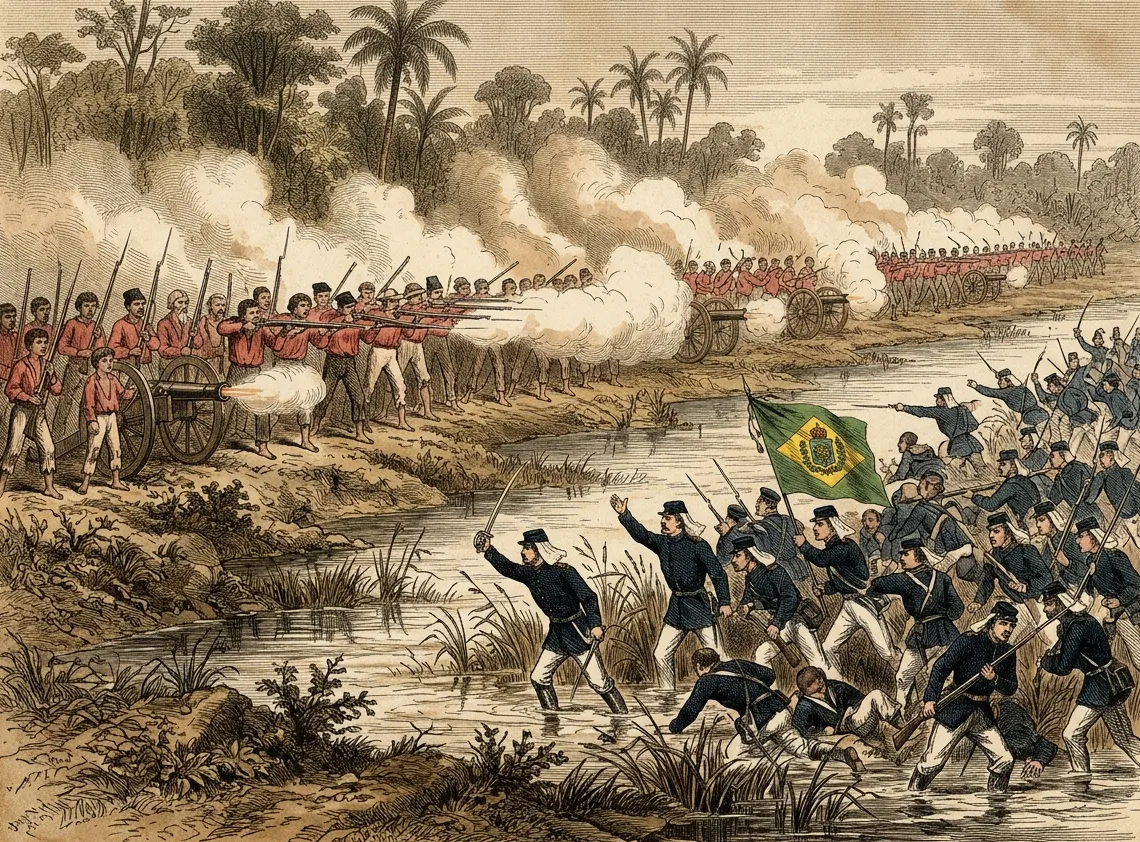
On 16 August, at around 8:30 a.m., the allies caught up with Caballero at Acosta Ñu.
Acosta Ñu is an open field of about 12 km², near Barrero Grande, where the Yuquyry stream joins the Piribebuy. For the Brazilians it was the battle of Campo Grande; in Guarani it is also called Ñu Guasu, the big field.
Caballero crossed the Yuquyry and formed his line on the far bank, with eight cannons. When the allied infantry tried to cross the stream, the first Paraguayan volley drove back the attack. Then the Count of Eu brought his artillery forward, and the rifled cannons opened fire on the line.
The imperial cavalry
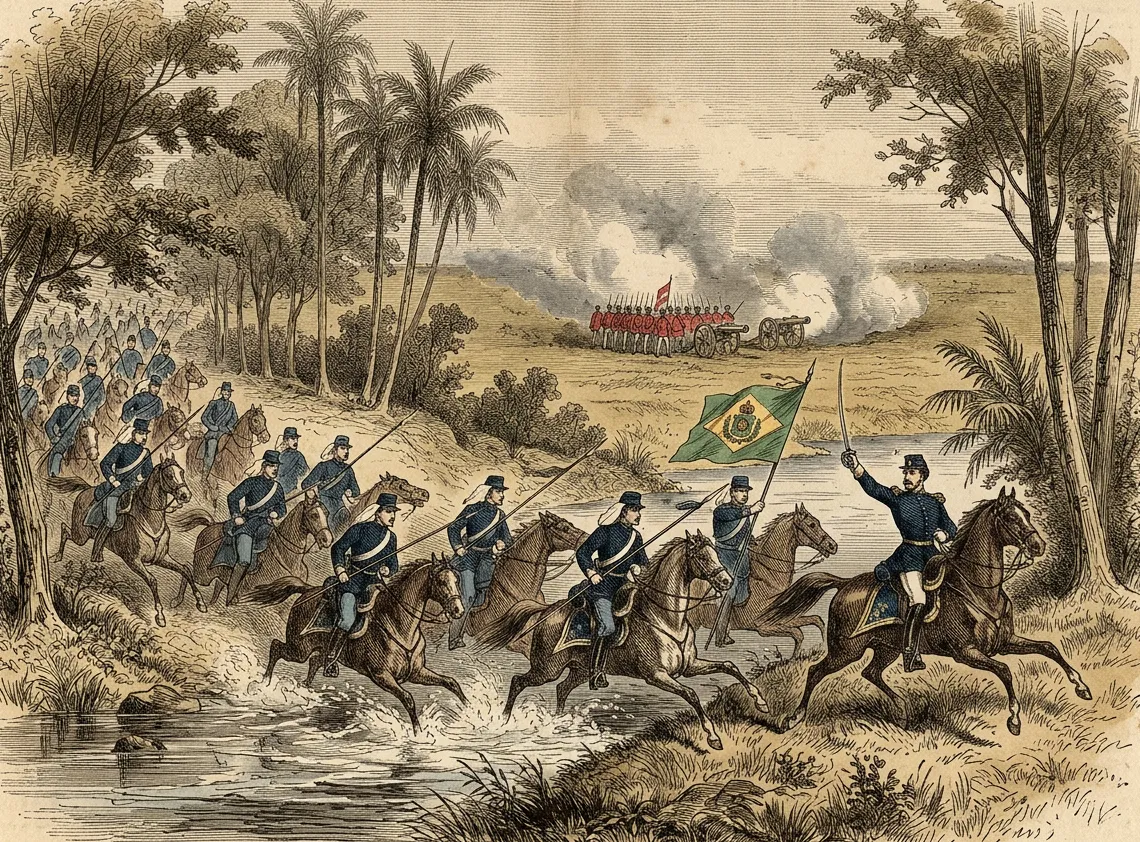
While the artillery struck from the front, the cavalry sought the flank.
The Brazilian 4th Cavalry Brigade crossed the Yuquyry to one side and charged the Paraguayan flank. In open country, the ground favored the horsemen.
The Paraguayans did not scatter. They formed a square and met the charges with the bayonet.
Hour after hour
The fighting went on for hours.
The rearguard fell back, re-formed and fought again. Around midday, according to the diary of the Brazilian officer Alfredo d'Escragnolle Taunay, secretary to the Count of Eu, the allied commander himself came under Paraguayan artillery and musket fire. At another point, a Paraguayan battalion came out from the edge of the woods and routed the infantry next to Taunay, until another Brazilian battalion stopped the attack.
So the afternoon came. Caballero's line was still on the field.
The fire
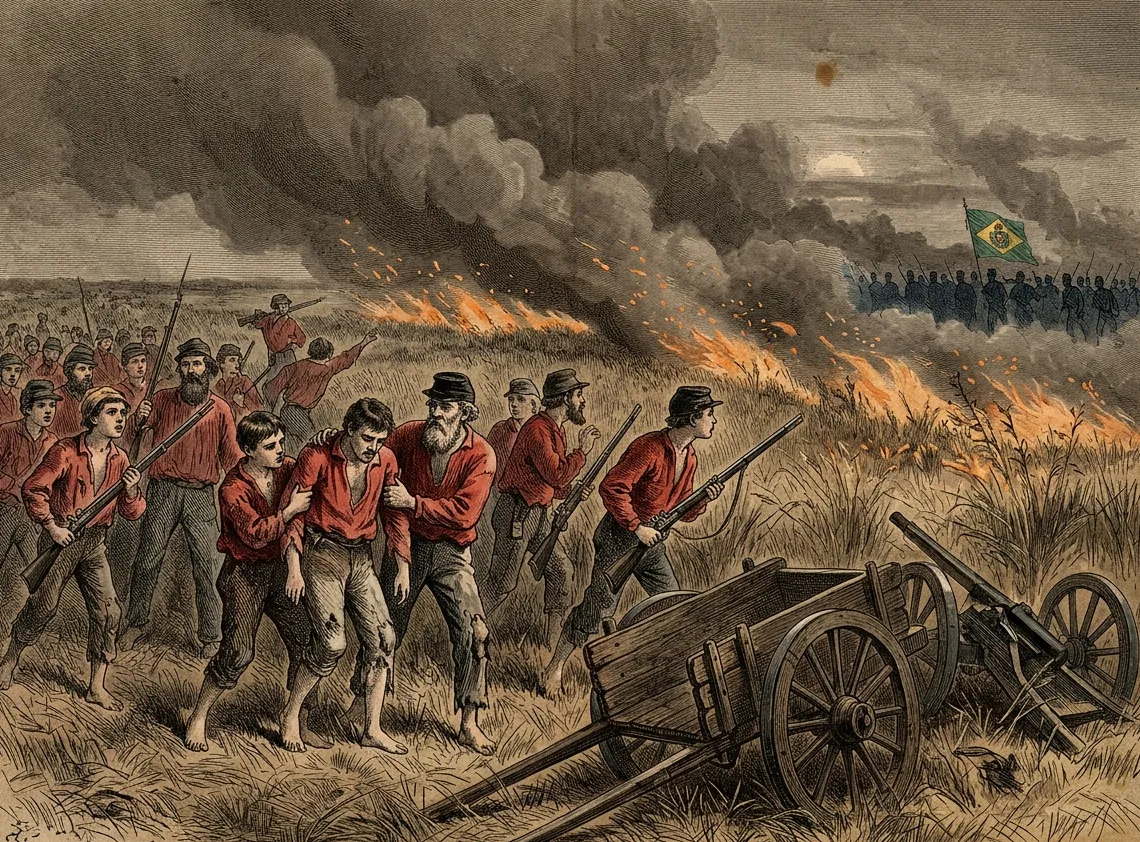
During the day, the dry grass began to burn.
August is the end of winter in Paraguay, and the field was dry. Smoke covered the plain and the flames advanced with the wind. The 1872 catalog of the great Brazilian painting of the battle describes the imperial infantry charging “over the burning brush”: the fire was burning while the fighting went on.
Who set the grass alight has been debated ever since. Taunay, a witness, wrote that the Paraguayans started the fire to cover themselves with the smoke and that the flames got out of control; many wounded men died in them. In 1979, Chiavenato accused the Count of Eu of ordering the field burned with the wounded and with the mothers who were searching for their children. The Paraguayan press and school textbooks repeat that version. No document proving that order has been found, and the historian Fabián Chamorro urges taking that version “with a grain of salt”, because there are no testimonies about intentions.
The encirclement
The final blow came from behind.
The allied 2nd Corps, with Campos's Argentine column, reached the Paraguayan rearguard and closed its line of retreat. The infantry charged with the bayonet, took the positions and captured the cannons.
Caballero escaped through the woods with a small group. According to Resquín's memoirs, the rearguard lost all its artillery, 87 carts with their oxen, weapons, ammunition and flags. When Caballero gathered his people again, he had 30 officers and 2,320 soldiers left.
Wounded and prisoners
The end of the fighting is the most disputed part of Acosta Ñu.
According to Resquín, more than 1,800 Paraguayans were taken prisoner; Brazilian sources speak of about 1,200. Many were wounded. The researcher Ángel Piccinini notes that some of them were treated in allied hospitals.
Paraguayan memory holds another image: children clinging to the soldiers' legs, who begged for their lives and had their throats cut. The most widespread account is Chiavenato's. The Brazilian memoirist Dionísio Cerqueira, who served in the campaign, recalled a large number of “little soldiers” covered in blood. A local tradition adds that the imperial troops stayed in the area for three days and killed whomever they found.
That there were prisoners is documented. The killing of wounded men and of men who had surrendered appears in tradition and in several authors, but not in the official reports. Its scale cannot be measured with the known documents.
The toll
Acosta Ñu was the last great pitched battle of the war.
- 3,500 to 6,000 Paraguayans in the rearguard ‡
- about 2,000 Paraguayan dead, according to the most cited figure ‡
- 1,200 to 1,852 Paraguayan prisoners ‡
- 285 to 602 allied casualties, dead and wounded ‡
While the rearguard fought, López's column went on toward Caraguatay. From then on, Paraguay no longer had an army able to stop the enemy: only columns in retreat.
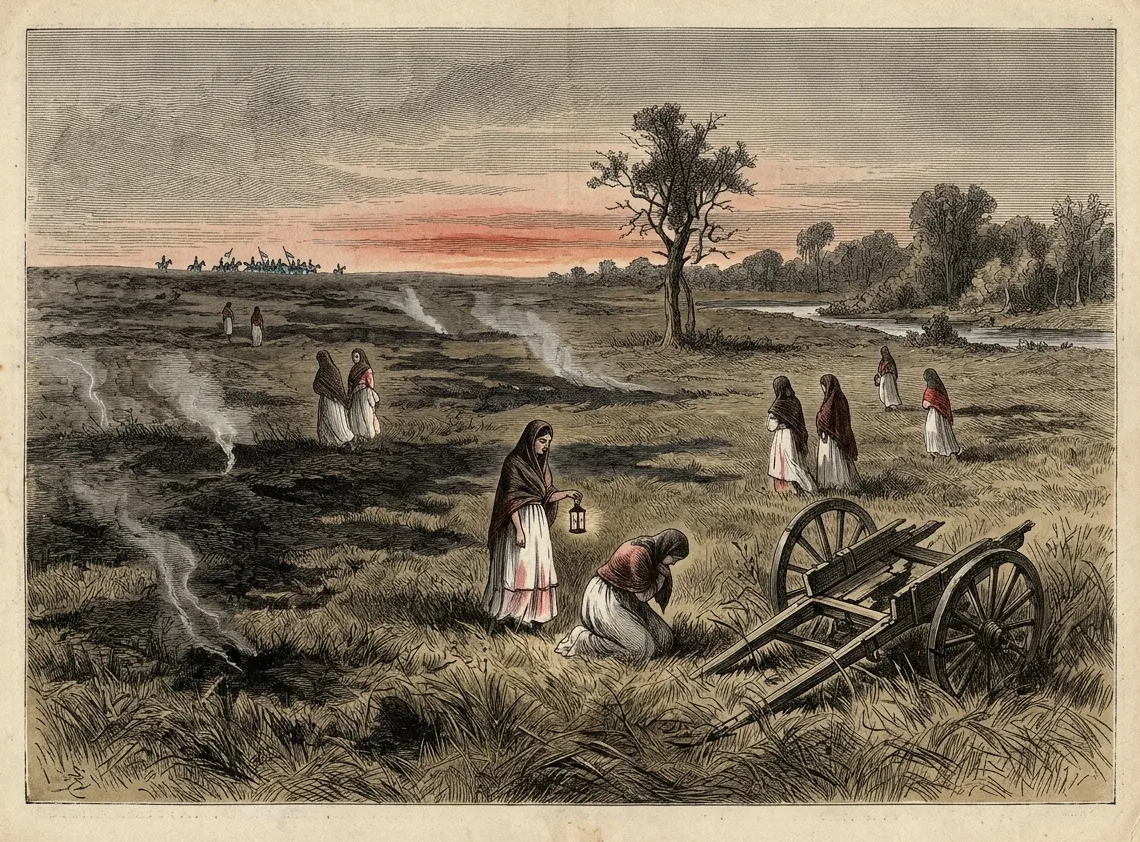
After Acosta Ñu
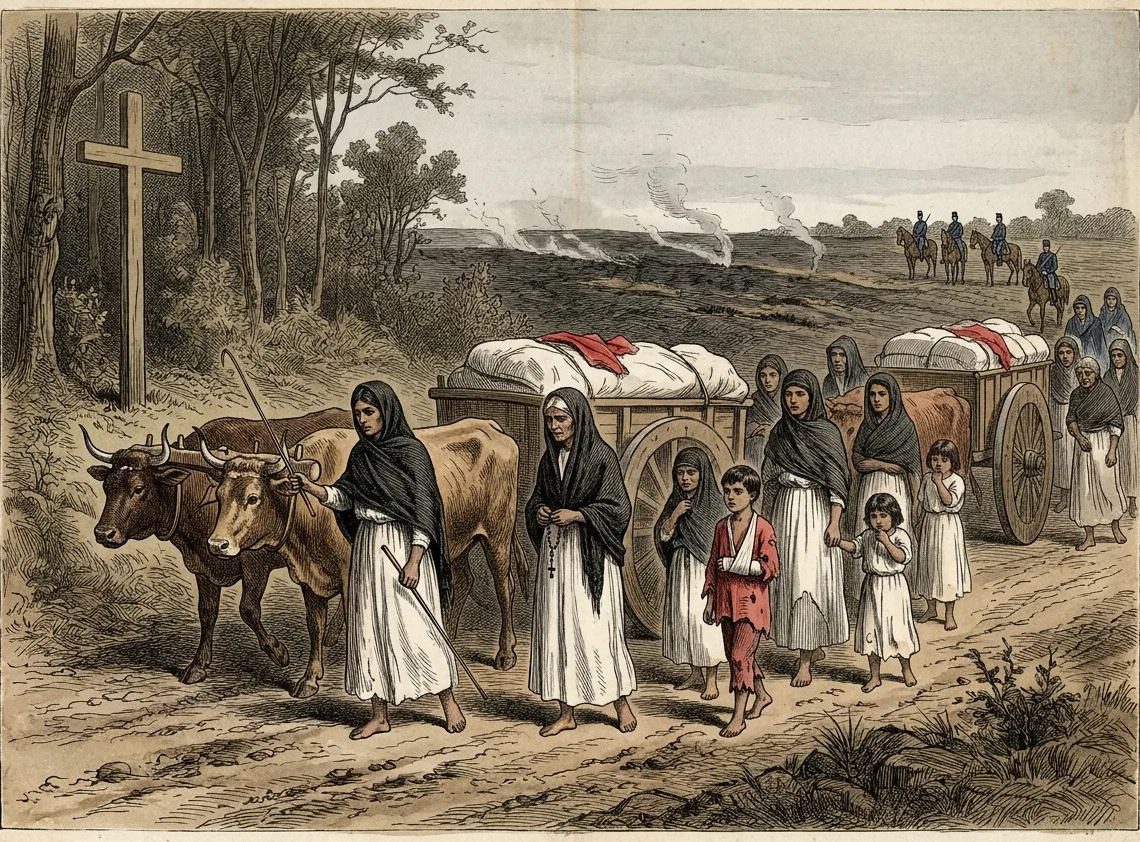
López escaped to the north. The war went on for six more months.
On 18 August, the Brazilians defeated another Paraguayan column at Caaguijurú, near Caraguatay. López marched ever farther north, with an ever smaller force.
According to local memory, women from Caraguatay carried the bodies of the boys in carts to Kurusu Dolores, in the rural district of Costa Ybaté. A wooden cross still marks the mass grave.
Bernardino Caballero survived and was president of Paraguay from 1880 to 1886. According to tradition, Emilio Aceval, then about 15 years old and president from 1898 to 1902, also came out of Acosta Ñu alive.
By Decree No. 27,484 of 19 July 1948, provisional president Juan Manuel Frutos set 16 August as Children’s Day (Día del Niño). The same decree adopted the name Acosta Ñu for the field that some memoirs called Rubio Ñu. Since 1919, Children’s Day had been celebrated on 13 May.
In 1871, the Brazilian painter Pedro Américo completed the Batalha de Campo Grande, a large canvas that glorifies the Count of Eu and the imperial army.
The memory of August
Acosta Ñu did not change the outcome of the war. It changed how the war is remembered.
While the rearguard held out, López's column gained distance. That resistance did not save Paraguay, but it did save, for a few months, part of its last army.
For decades, the date was celebrated. Today historians such as Herib Caballero Campos and Amancio Ruiz Díaz call for commemoration rather than celebration. “A tragedy cannot be celebrated”, says Ruiz Díaz.
Between epic and horror lies a question: how a war came to put guns in the hands of children. And there remains a reason to return to that field every 16 August: so that the courage of those young guardians is never forgotten.
Sources
- Terry D. Hooker, The Paraguayan War (2008), pp. 103-104, as cited in English Wikipedia: course of the battle, crossing of the Yuquyry, square, 2nd Corps and Campos's column.
- Alfredo d'Escragnolle Taunay, A campanha da Cordilheira. Diário do Exército and Recordações de guerra e de viagem, cited by Maraliz de Castro Vieira Christo, “Quando subordinados roubam a cena”, Sæculum 19 (2008), and by English Wikipedia: the Count under fire, the Paraguayan counterattack, the origin of the fire.
- Francisco Isidoro Resquín, memoirs, as cited in Spanish Wikipedia and by Ángel Piccinini: forces, dead, prisoners, survivors, carts.
- Ángel Piccinini, “El Día del Niño y el populismo nacionalista”, Última Hora (2025): 1948 decree, age of recruitment, prisoners in hospitals.
- Última Hora: the children of Acosta Ñu, with Herib Caballero Campos and Amancio Ruiz Díaz.
- La Nación (Paraguay): Kurusu Dolores, with Fabián Chamorro (2022); Emilio Aceval (2022); Acosta Ñu (2020); 75 years of Children’s Day (2023).
- ABC Color: “Acosta Ñu: retazos del ayer”; “Los mártires de Acosta Ñu, ¿héroes o víctimas?” (2019).
- Poder Judicial del Paraguay: Decree No. 27,484 of 1948.
- César Iván Bondar, “La Batalla de los niños”, Revista Sans Soleil 9 (2017).
- Wikipedia, English and Spanish: Acosta Ñu, Bernardino Caballero, Cordillera campaign. Only as cross-checking support.
Disputed points
- Paraguayan forces: from 3,500 to 6,000. Allied: about 20,000 in the area, not all in combat.
- Paraguayan cannons: 8 to 12.
- Ages: 12 to 14 according to most historians; 6 to 8 according to Chiavenato.
- False beards: no period source.
- Women combatants at Acosta Ñu: tradition.
- Duration: from five to eight hours.
- Who started the fire and when: Taunay or Chiavenato.
- Deaths of wounded men and prisoners: tradition and Chiavenato; absent from the reports.
- Casualties: from 1,794 to 3,300 Paraguayan dead and from 1,200 to 1,852 prisoners; from 26 to 182 allied dead.
- Date of López's departure: 12 to 14 August.
Six months after Acosta Ñu, on 1 March 1870, the pursuit of López ended on the banks of the Aquidabán, at Cerro Corá.
Open in the illustrated encyclopedia ›
Guerra Guasu Collection · by José Báez · Free for everyone · Home · Privacy