Riachuelo
The battle that closed the river · 11 June 1865 · Corrientes campaign
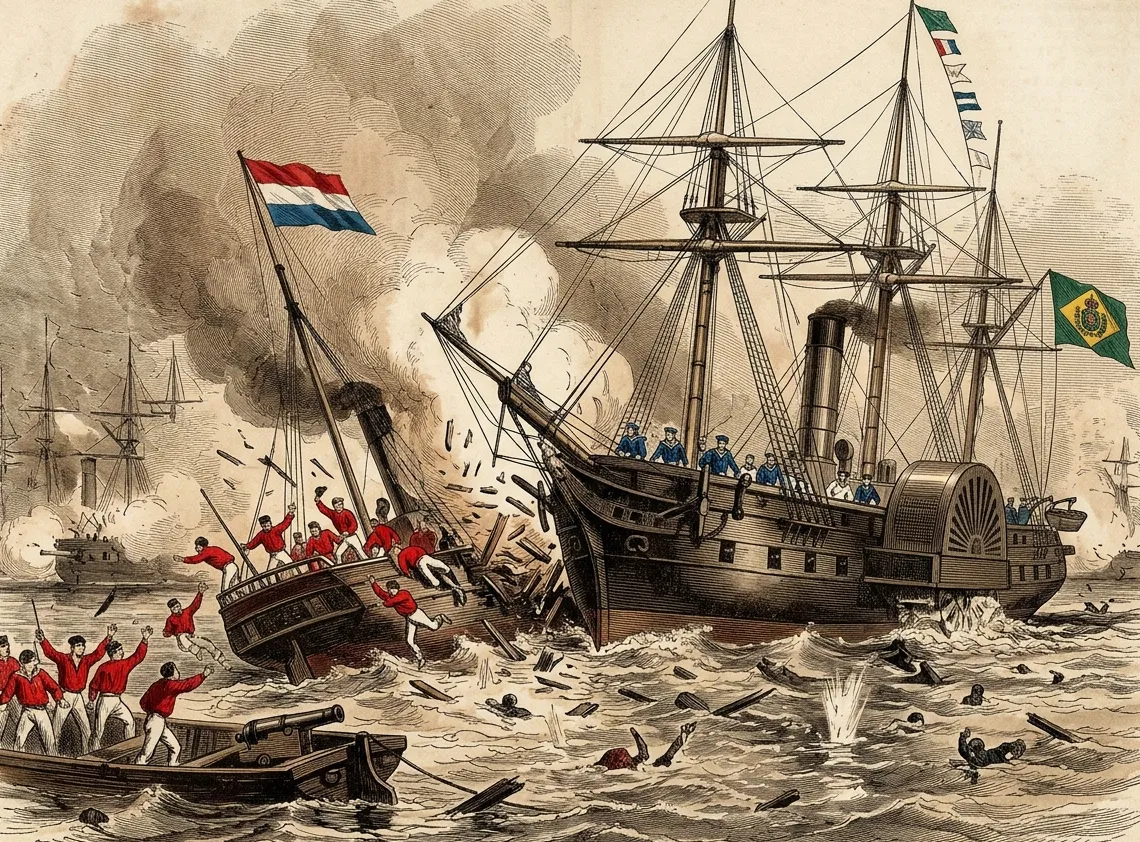
Battle card
| Date | Sunday, 11 June 1865 | |
|---|---|---|
| Location | Paraná River, off the mouth of the Riachuelo stream, downstream from Corrientes | |
| War | Triple Alliance · Corrientes campaign | |
| Duration | About 7 or 8 hours, from around 9 a.m. ‡ | |
| Result | Brazilian victory. The Paraguayan squadron loses four steamers and all its chatas. | |
| Paraguay | Empire of Brazil | |
| Commanders | Captain Pedro Ignacio Meza (squadron, aboard the Tacuarí) José María Bruguez (shore batteries) | Division commander Francisco Manuel Barroso da Silva (aboard the frigate Amazonas) |
| Forces | 8 steamers and 6 or 7 chatas ‡ On shore: 22 cannons, Congreve rockets and 2,000 to 3,000 infantrymen ‡ | 9 wooden-hulled steamers About 1,100 sailors and 1,200 embarked soldiers |
| Ships | Tacuarí (flagship), Paraguarí, Igurey, Yporá, Marqués de Olinda, Jejuí, Salto Oriental and Pirabebé | Amazonas (flagship), Jequitinhonha, Belmonte, Parnaíba, Beberibe, Mearim, Iguatemi, Araguari and Ipiranga |
| Artillery | About 30 cannons on the steamers and one heavy gun on each chata | 59 cannons, 3 of them rifled Whitworths |
| Casualties | About 750 according to Paraguay itself; twice that according to Masterman ‡ 4 steamers and all the chatas | 242 to 266 dead, wounded and missing ‡ 1 ship: the Jequitinhonha |
‡ Figure disputed among sources. No source gives the total number of men aboard the Paraguayan squadron.
A note to the reader
Each page carries a mark that shows what kind of information you are reading.
The plates in this work are contemporary illustrations, made in the manner of period engravings. They are not original documents.
The river of war
In June 1865, the war was being played out on the Paraná River, off the Argentine city of Corrientes.
On 13 April, five Paraguayan steamers under Pedro Ignacio Meza captured two Argentine steamers in the port of Corrientes, the 25 de Mayo and the Gualeguay. The next day, Paraguayan troops occupied the city. On 1 May, Argentina, the Empire of Brazil and Uruguay signed the treaty of the Triple Alliance in Buenos Aires.
To close the river to the Paraguayan army, a Brazilian squadron of nine steamers went up the Paraná and anchored downstream from Corrientes, near the mouth of the Riachuelo stream. It was short of meat, hardtack and coal, and had some two hundred sick men on board.
Boarding in the dark
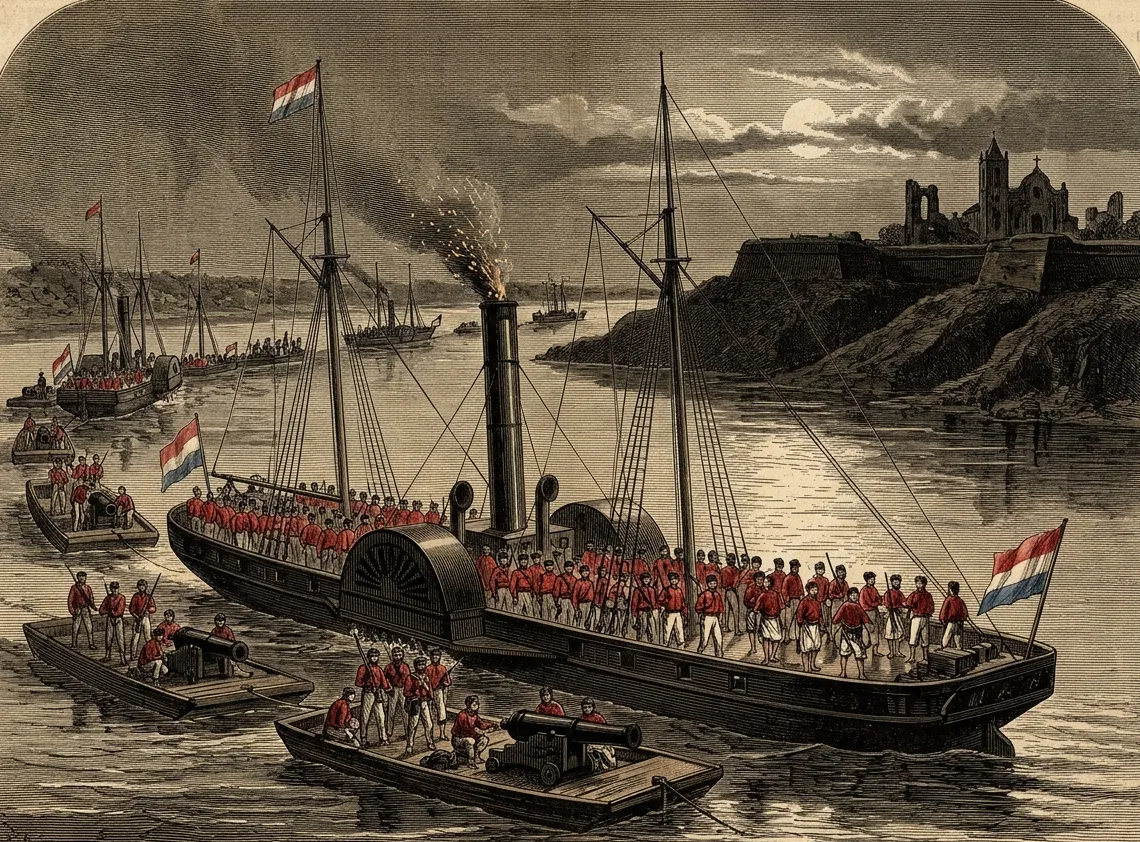
The Paraguayan plan was bold: to fall on the Brazilian squadron at night and take its ships by boarding.
In an artillery duel, the Paraguayans were bound to lose. That is why the plan relied on surprise: leave Humaitá at eight in the evening on 10 June, steam about seven hours downriver and arrive in the early hours, with the Brazilians asleep. Nine steamers would carry soldiers for the boarding: about 500 men of the 6th Battalion, according to the engineer George Thompson.
The steamers would also tow six chatas, each armed with a 68-pounder. On shore, the artillery chief José María Bruguez was ordered to bring 22 light cannons and Congreve rockets to the bluff next to the Riachuelo.
Two commanders
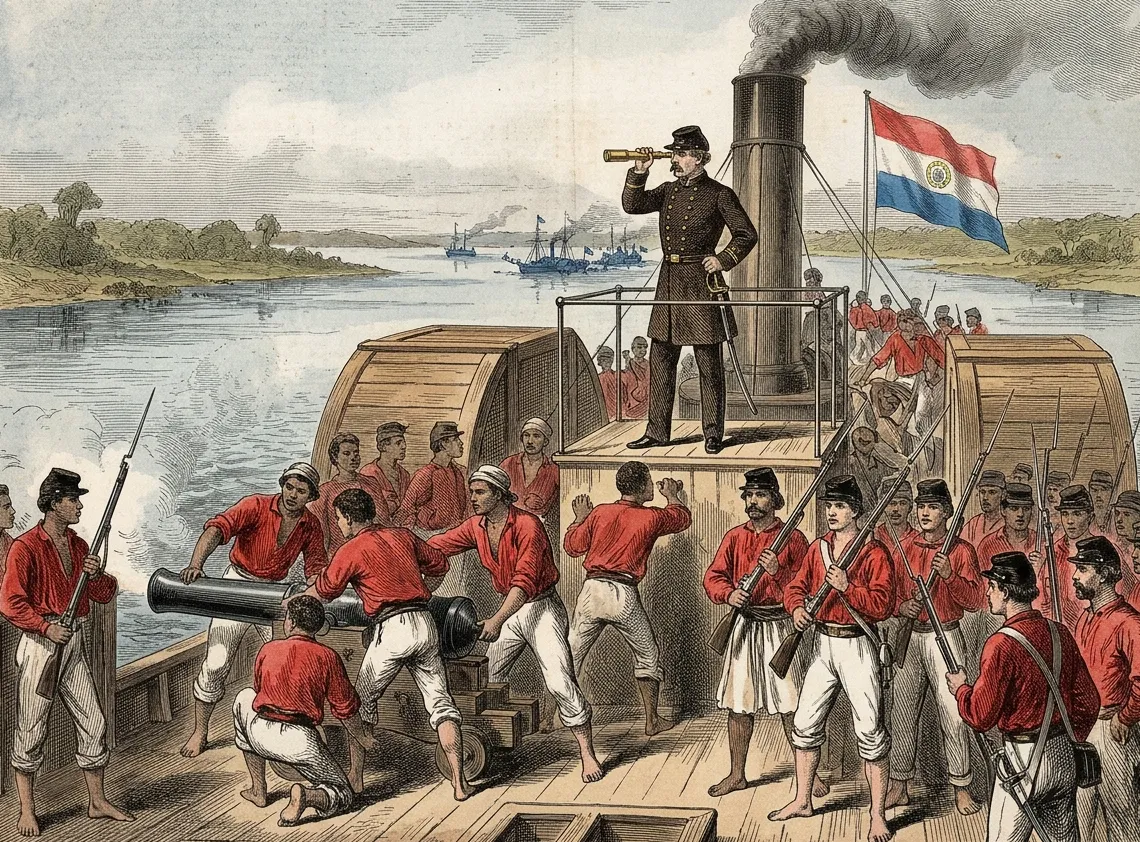
At the head of the Paraguayan squadron was Captain Pedro Ignacio Meza, aboard the Tacuarí, the flagship.
He was born in Asunción, probably in 1813: he was about 52 years old. Two months earlier he had commanded the capture of the Argentine steamers at Corrientes.
Facing him was Francisco Manuel Barroso da Silva, aboard the frigate Amazonas. He was born in Lisbon in 1804 and had served in the Brazilian Navy since his youth. He was 60 years old.
The lost night
On the night of 10 June, nothing went to schedule.
The order to sail came late, and the squadron only left Humaitá after midnight. On the way, the chatas had to be gathered. Near Tres Bocas, where the Paraguay River flows into the Paraná, the propeller of the Yberá broke down. Hours were lost on repairs, without success, and the Yberá was left behind. Eight steamers went on.
By the time the squadron was under way again, it was already daylight. According to the marine engineer Gibson, an officer advised waiting for the following night. Meza ordered them to press on.
The run past
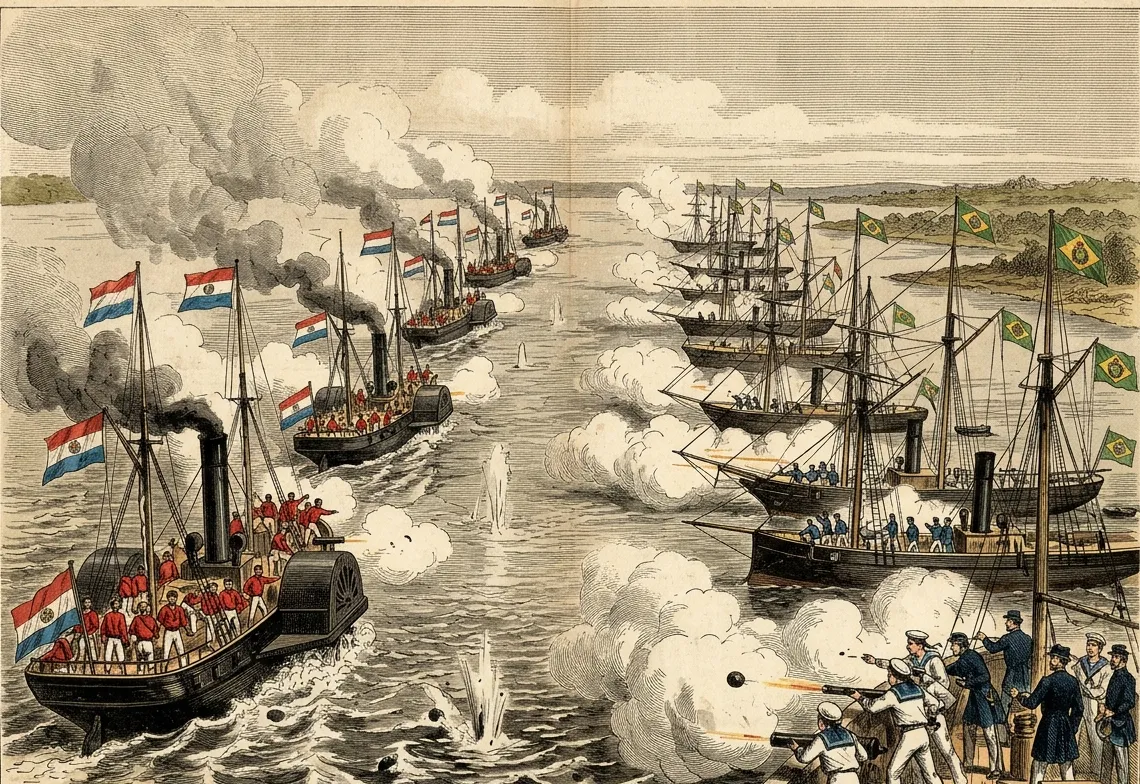
Around nine in the morning on Sunday 11 June, the Brazilian lookouts saw the smoke of the Paraguayan steamers coming downriver.
Surprise was no longer possible. Instead of boarding, Meza steamed past the anchored squadron, downriver, firing as he went. The Brazilians ran to their guns and returned fire.
Farther down, the Paraguayans turned and came back to the mouth of the Riachuelo. There they formed their line, with the chatas anchored close to the bank, under the protection of Bruguez's batteries. To reach them, the Brazilians would have to come down the channel, at the foot of the bluff.
Bruguez's batteries
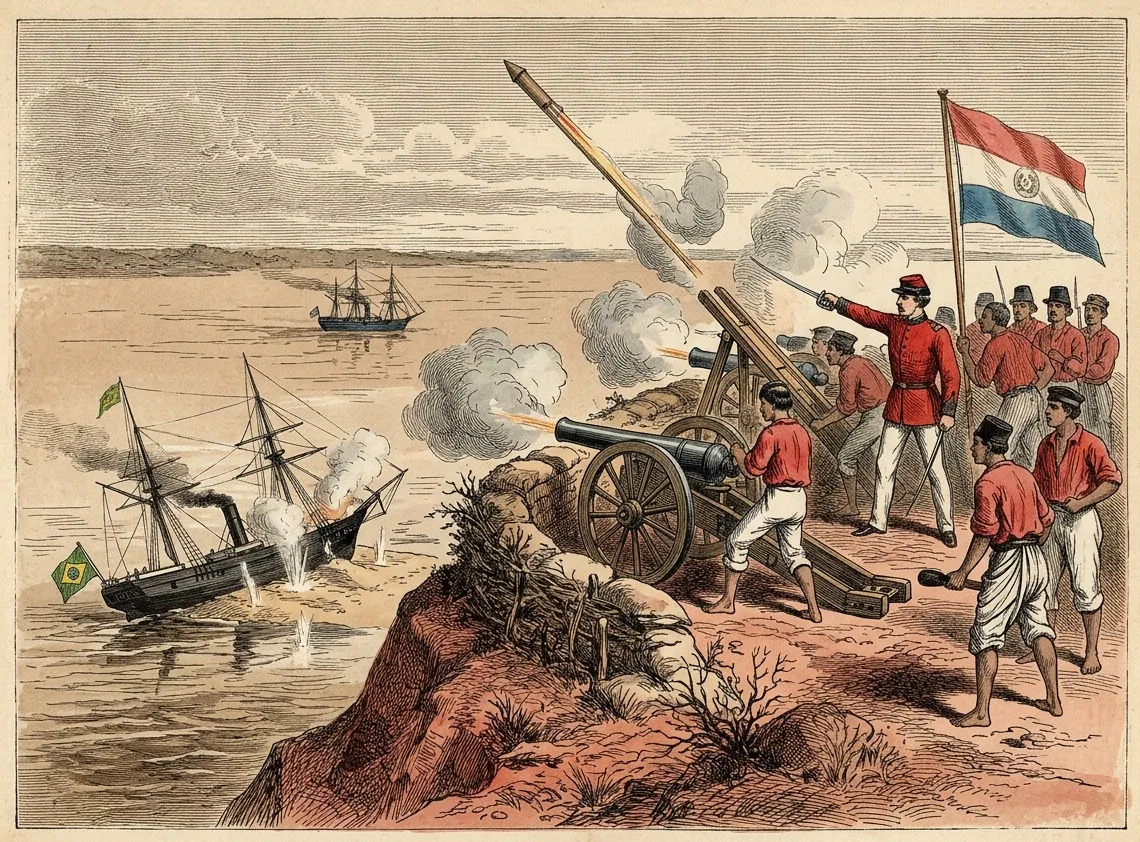
Barroso gave the order to attack. His line came down the channel along the Corrientes shore, without spotting the battery on the bluff.
From above, Bruguez's cannons and the Congreve rockets rained down on the leading ships. The Belmonte, at the head of the line, was left alone under fire from the shore and from Meza's steamers. With water in her hull, she was run aground on Cabral Island to keep her from sinking.
The Jequitinhonha, which came second, turned and ran aground on a sandbank, within range of the bluff. The Brazilian line was split.
The boarding of the Parnaíba
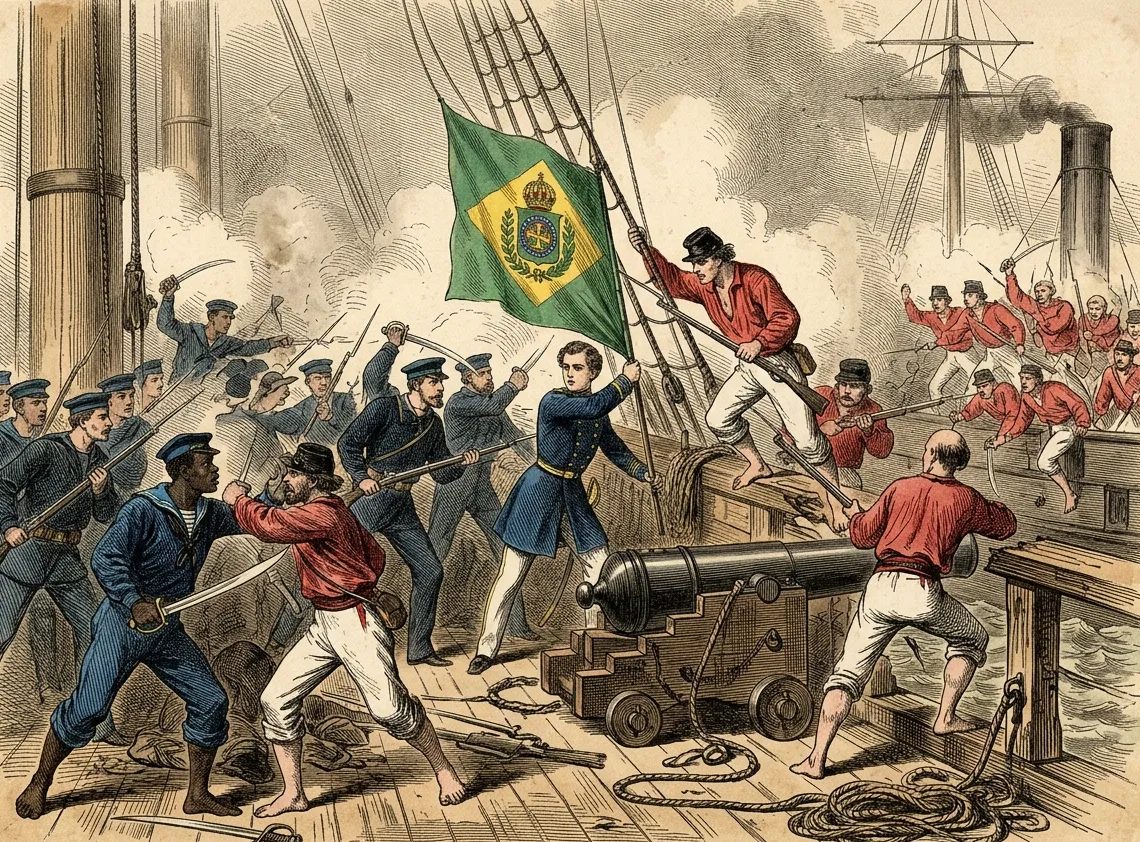
The Parnaíba came back to help the Jequitinhonha. A shot broke her rudder, and she was left at the mercy of the Paraguayan steamers.
It was time for boarding. The Tacuarí came alongside on one side, but her large paddle wheels kept her from closing with the hull: only two men managed to jump across. The Salto Oriental came alongside on the other, and some thirty soldiers of the 6th Battalion jumped onto the deck. They took the stern, hauled down the imperial flag and raised the Paraguayan one.
On the other side, the crew and soldiers of the Brazilian 9th Battalion fought back with sabers and bayonets. Midshipman Greenhalgh, aged 19, died there, and so did Marcílio Dias, a Black sailor from Rio Grande do Sul, aged 27. For the Brazilian Navy they are heroes to this day. In the fighting, Meza was hit in the chest by a musket ball.
The ramming
Barroso had a weapon no one expected: his own ship.
The Amazonas was a 1,050-ton paddle frigate, the largest ship on either side. Barroso hoisted the signal “O Brasil espera que cada um cumpra o seu dever”: Brazil expects each man to do his duty. With the ships he had left, he turned back toward the Paraguayan line and used his bow as a ram.
One after another, the Amazonas rammed the Jejuí, which sank; the Salto Oriental, which capsized; the Marqués de Olinda; and the Paraguarí, which was left aground on Palomera Island. She also sank a chata. The Marqués de Olinda was the Brazilian steamer captured by Paraguay in November 1864, the event that started the war.
The retreat
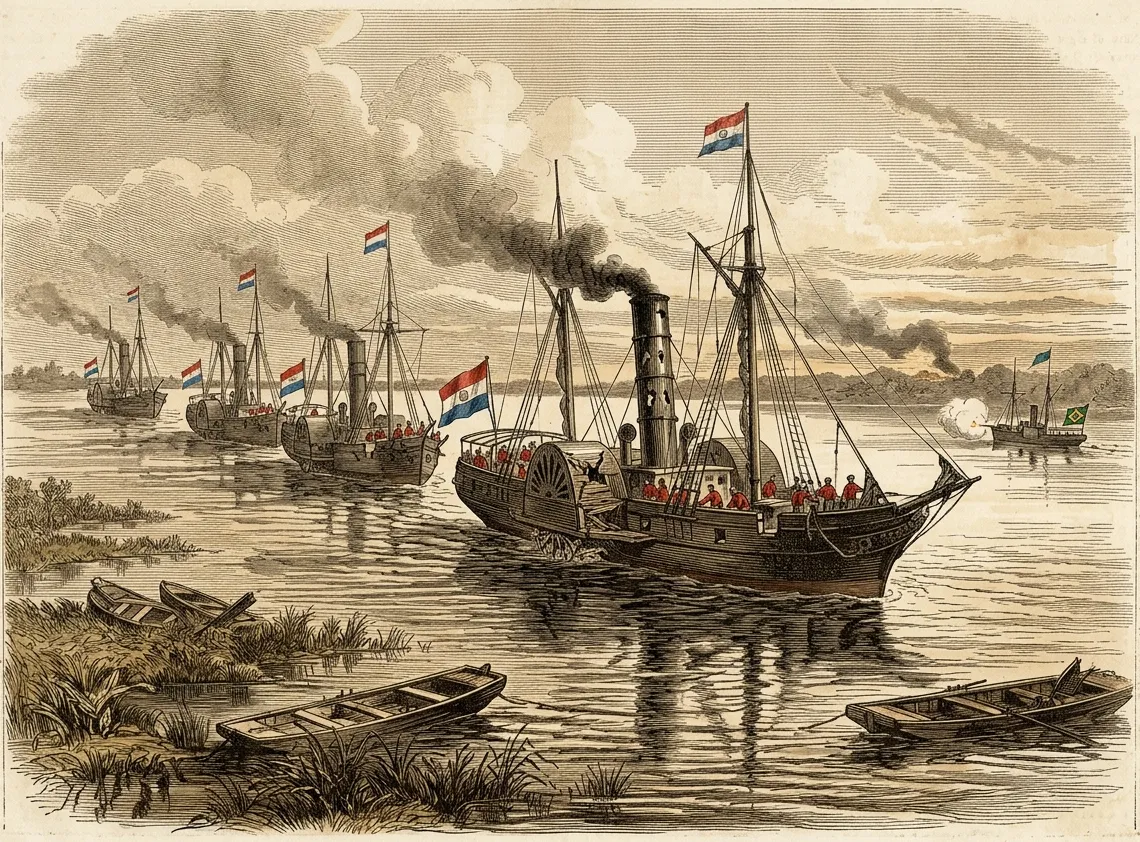
Around four in the afternoon, the Paraguayans withdrew upriver.
Four steamers escaped, all of them damaged: the Tacuarí, the Igurey, the Yporá and the Pirabebé. The Araguari went after them, until at half past five she received the order to return: night was coming.
The chatas were left on their own and all were lost. Lieutenant Ezequiel Robles, commander of the Marqués de Olinda, was taken prisoner with a shattered arm; the arm was amputated and he died on 14 June.
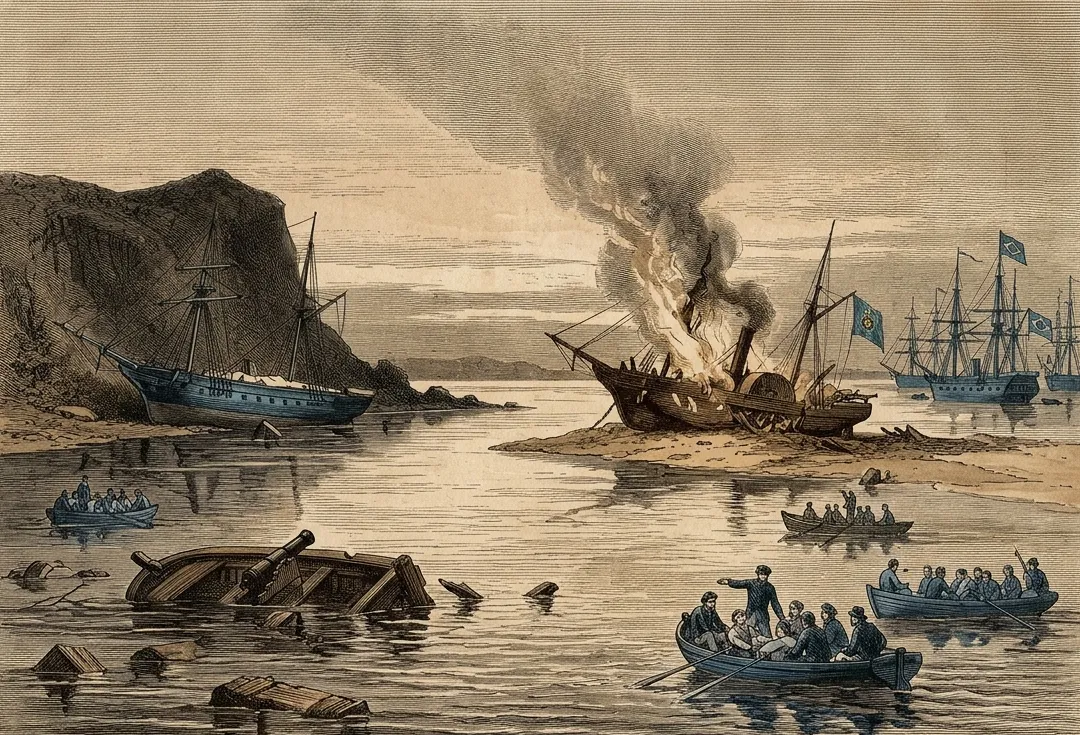
The attempts to refloat the Jequitinhonha failed, and her crew abandoned the ship. The Paraguayans later carried off her cannons, and the hull ended up burned.
The toll
In a single day, the Paraguayan navy lost half of the steamers that went into battle.
- 4 of 8 Paraguayan steamers lost
- 750 to 1,500 Paraguayan casualties, depending on the source
- 1 of 9 Brazilian ship lost
- 242 to 266 Brazilian casualties, depending on the source
Paraguay lost the Jejuí, the Salto Oriental, the Marqués de Olinda and the Paraguarí, and all its chatas. Brazil lost the Jequitinhonha. The Brazilian ship with the most casualties was the Parnaíba: 33 dead, 28 wounded and 14 missing.
After Riachuelo
The Paraguayan squadron never again sought battle with the Brazilian one.
Meza died at Humaitá of his chest wound. According to one version, López said that if he had not died of one bullet, he would have had to die of four, and he forbade the officers to attend the burial.
Bruguez took his cannons downriver and, in August, shelled the squadron again at Paso de Mercedes and Paso de Cuevas. But the river already had an owner. Without support by water, the Paraguayan column on the Paraná was halted at Corrientes, and the one on the Uruguay River surrendered at Uruguaiana on 18 September. By early November, the Paraguayan army had finished crossing back over the Paraná.
In 1866 Barroso received the title of Baron of Amazonas, after the name of his frigate. In Brazil, 11 June is still Navy Day. The Tacuarí remained in service until 1868, when her own crew scuttled the ship so that she would not fall into enemy hands.
A closed river
Riachuelo began to be lost before the first cannon shot, in the lost hours of the night.
The plan depended on darkness and on boarding. Without the night, eight steamers, almost all of them armed merchant ships, were left facing nine warships in daylight. From that Sunday on, the Paraná and the Paraguay were roads of the Empire, and the country was shut in. The war would be fought on Paraguayan soil.
Sources
- Pablo Palermo, “La batalla de Riachuelo”, Revista de Historia Naval no. 160 (Armada Española, 2023). Plan, delays, ships and crews, sequence of the battle, boarding of the Parnaíba, rammings, casualties according to Von Hoonholtz, deaths of Meza and Ezequiel Robles. Brings together the accounts of Thompson, Centurión, Gibson and Masterman.
- Jaime E. Grau Paolini and Manuel A. Iricíbar, “La batalla naval del Riachuelo”, Boletín del Centro Naval no. 822 (2008). Times, distances, breakdown of the Yberá, rammings.
- Sergio W. de Castro Oliveira Filho, Navigator no. 34 (Marinha do Brasil, 2021). Shortage of provisions and coal in Barroso's squadron.
- Marinha do Brasil, order of the day for the 156th anniversary of Riachuelo. Barroso's signals, Greenhalgh and Marcílio Dias.
- Álvaro Pereira do Nascimento, “O marinheiro negro Marcílio Dias”, Navigator (2020).
- Imperial decree of 18 November 1865, creating the Riachuelo medal. Casualties acknowledged by each side.
- La Nación (Paraguay), “El resurgimiento del Paraguarí” (2019).
- Battle of the Riachuelo, Corrientes campaign, Pedro Ignacio Meza, Francisco Manuel Barroso and Brazilian corvette Jequitinhonha, English Wikipedia; Batalla del Riachuelo, Spanish Wikipedia. Cross-checking.
Disputed points
- Paraguayan casualties: about 750 or twice that. Brazilian casualties: from 242 to 266.
- Men for the boarding: from 500 to 1,600. Chatas: six or seven.
- Bruguez's cannons and their caliber; number of rocket batteries.
- Order of the rammings by the Amazonas, and who ran the Paraguarí aground.
- How the Parnaíba was recovered; Marcílio Dias's fight against four Paraguayans.
- Date of Meza's death: 15, 19 or 28 June. His rank and that of Bruguez.
- Whether Meza disobeyed López by steaming past.
- Fog or clear skies; exact location of the Brazilian anchorage.
- Who set fire to the Jequitinhonha.
In April 1866, with the river in their hands, the allies crossed the Paraná at Paso de la Patria. On 24 May, at Tuyutí, the largest battle of the war was fought.
Open in the illustrated encyclopedia ›
Guerra Guasu Collection · by José Báez · Free for everyone · Home · Privacy